Washing Machine Not Spinning? Why Your Clothes Come Out Soaking Wet
Washing Machine Not Spinning? Why Your Clothes Come Out Soaking Wet
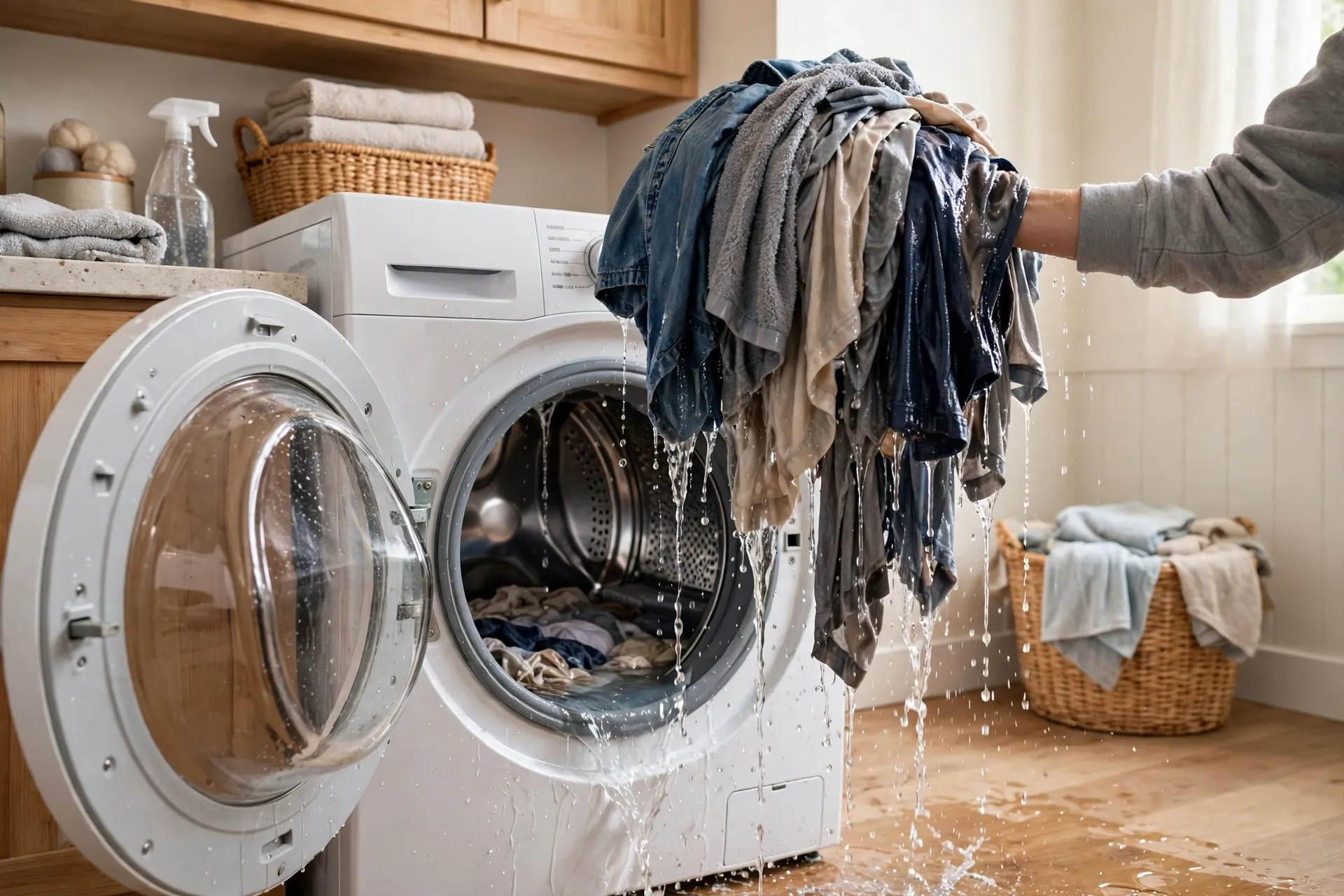
The cycle ends, you open the lid, and your clothes are still soaking wet. The machine seems to have done everything except the last step.
First, an important distinction: if standing water is left in the drum, that is a drain problem, not a spin problem — see our article on a washing machine that won’t drain. This article covers the other case: the water drained away, but the drum never reached full spin speed, so your clothes stayed wet.
1. An Unbalanced Load
This is the most common cause, and the easiest to fix. A washer will not spin at high speed if the load is unbalanced, because the drum would shake itself apart.
The classic culprit is a single heavy item — a rug, bath mat, or heavy blanket — washed with light items like sheets. It clumps to one side, the machine senses the imbalance, and it refuses high-speed spin.
Open the washer, redistribute the load evenly around the drum, and add a few similar-weight items if you are washing one heavy piece alone. Then run a drain-and-spin cycle. If it spins fine with a balanced load, you have found your answer.
2. A Spin Speed Set Too Low
Sometimes the machine is doing exactly what it was told to do. Delicates and hand-wash cycles use a slow spin, or no spin at all, to protect fragile fabrics. If your clothes come out wet after a delicates cycle, that may be normal for that setting.
Check the cycle and spin-speed setting you used. If you can select a higher spin speed, try a normal cycle with the spin set to high and see if the clothes come out drier. This is easy to overlook, and it costs nothing to check.
3. A Faulty Lid Switch or Door Lock
A washer will not spin if it thinks the lid or door is open. On a top-loader, the lid switch sends that signal. On a front-loader, the door lock does the same job.
Listen for a click when you close the lid, or check whether the door-lock light comes on. If there is no click, or the machine fills and washes but never attempts to spin, the switch or lock may be worn out. Reaching these parts usually means opening a panel, so this is a good job for a technician if you are not comfortable with it.
Note that the lid switch also affects draining. If your drum still has standing water in it, read our washing machine won’t drain article instead.
4. A Worn Drive Belt
On many top-load washers, a belt connects the motor to the transmission. Over time, belts stretch, crack, or slip. A slipping belt may let the washer agitate weakly but fail to spin the drum fast enough to wring out the clothes.
Signs of a worn belt include a burning rubber smell during the cycle, or a drum that struggles and slows down under load. Checking a belt means opening the machine’s back or bottom panel, which is best left to a technician unless you are confident doing it.
5. A Failed Motor Coupling (Top-Load Washers)
Many top-load washers use a small motor coupling — a plastic-and-rubber part that connects the motor to the transmission — instead of a belt. It is designed to break under stress to protect the motor, so it is a common failure point.
A broken coupling often shows up as a washer that fills and drains but does not agitate or spin, even though the motor sounds like it is running. Replacing it requires opening the machine and removing the motor, so it is a technician job for most homeowners.
6. Suspension Wear Tripping the Imbalance Sensor
The drum hangs on suspension rods or shock absorbers that keep it steady during spin. When those wear out, the drum wobbles more than it should, and the imbalance sensor trips — even with a normal load. The machine then slows or stops the spin to protect itself.
This cause is harder to spot, because the load looks fine. A clue is a drum that feels loose, or a machine that has started shaking more during spin. If vibration is the main thing you notice, rather than just wet clothes, see our article on a washing machine shaking violently.
When to Call a Technician
Call a technician if any of these apply:
- Redistributing the load and raising the spin speed do not help.
- The lid switch shows no click, or the door lock never engages.
- The motor runs but the drum does not spin or agitate.
- You smell burning rubber, or the drum feels loose and wobbly.
- The problem keeps coming back with normal, balanced loads.
A technician can test the lid switch, belt, coupling, and suspension. Repair cost varies depending on the part and the model, so ask for an estimate before work begins.
Frequently Asked Questions
Why are my clothes still soaking wet after washing?
Most often, the drum never reached high-speed spin. Common causes are an unbalanced load, a low spin setting, a faulty lid switch or door lock, a worn belt, a failed motor coupling, or worn suspension tripping the imbalance sensor.
My washer drains but the clothes come out wet — is that the same as a drain problem?
No. If the water drained away but the clothes are still wet, that is a spin problem. A drain problem leaves standing water in the drum. The two need different fixes, which is why they are covered in separate articles.
Why won’t my washer spin a single heavy item?
A single heavy item, like a rug or blanket, clumps to one side and creates an imbalance. The machine senses this and refuses high-speed spin to avoid damage. Wash heavy items with a few similar-weight pieces, distributed evenly.
Why does my washer spin sometimes but not others?
An intermittent spin problem often depends on the load: a balanced load spins fine, an unbalanced one does not. A lid switch that works only sometimes, or a belt that slips only under a heavy load, can also cause this.
Can a low spin setting really leave clothes soaking wet?
Yes. Delicates and hand-wash cycles use a slow spin, or sometimes no spin, to protect fragile fabrics. If you used one of those cycles, try a normal cycle with the spin speed set to high and compare the result.
Is it safe to keep running a washer that won’t spin?
It is best to find the cause first. Repeatedly running unbalanced loads strains the suspension and can make the problem worse. If redistributing the load does not fix it, get it checked before it leads to a bigger repair.
Need Help in Abilene?
If you have tried the checks above and your clothes still come out soaking wet, a local technician can diagnose the spin problem. For washing machine repair in Abilene, TX, see our washing machine repair page or call (325) 339-1818.
Why are my clothes still soaking wet after washing?
Most often, the drum never reached high-speed spin. Common causes are an unbalanced load, a low spin setting, a faulty lid switch or door lock, a worn belt, a failed motor coupling, or worn suspension tripping the imbalance sensor.
My washer drains but the clothes come out wet — is that the same as a drain problem?
No. If the water drained away but the clothes are still wet, that is a spin problem. A drain problem leaves standing water in the drum. The two need different fixes, which is why they are covered in separate articles.
Why won’t my washer spin a single heavy item?
A single heavy item, like a rug or blanket, clumps to one side and creates an imbalance. The machine senses this and refuses high-speed spin to avoid damage. Wash heavy items with a few similar-weight pieces, distributed evenly.
Why does my washer spin sometimes but not others?
An intermittent spin problem often depends on the load: a balanced load spins fine, an unbalanced one does not. A lid switch that works only sometimes, or a belt that slips only under a heavy load, can also cause this.
Can a low spin setting really leave clothes soaking wet?
Yes. Delicates and hand-wash cycles use a slow spin, or sometimes no spin, to protect fragile fabrics. If you used one of those cycles, try a normal cycle with the spin speed set to high and compare the result.
Is it safe to keep running a washer that won’t spin?
It is best to find the cause first. Repeatedly running unbalanced loads strains the suspension and can make the problem worse. If redistributing the load does not fix it, get it checked before it leads to a bigger repair.